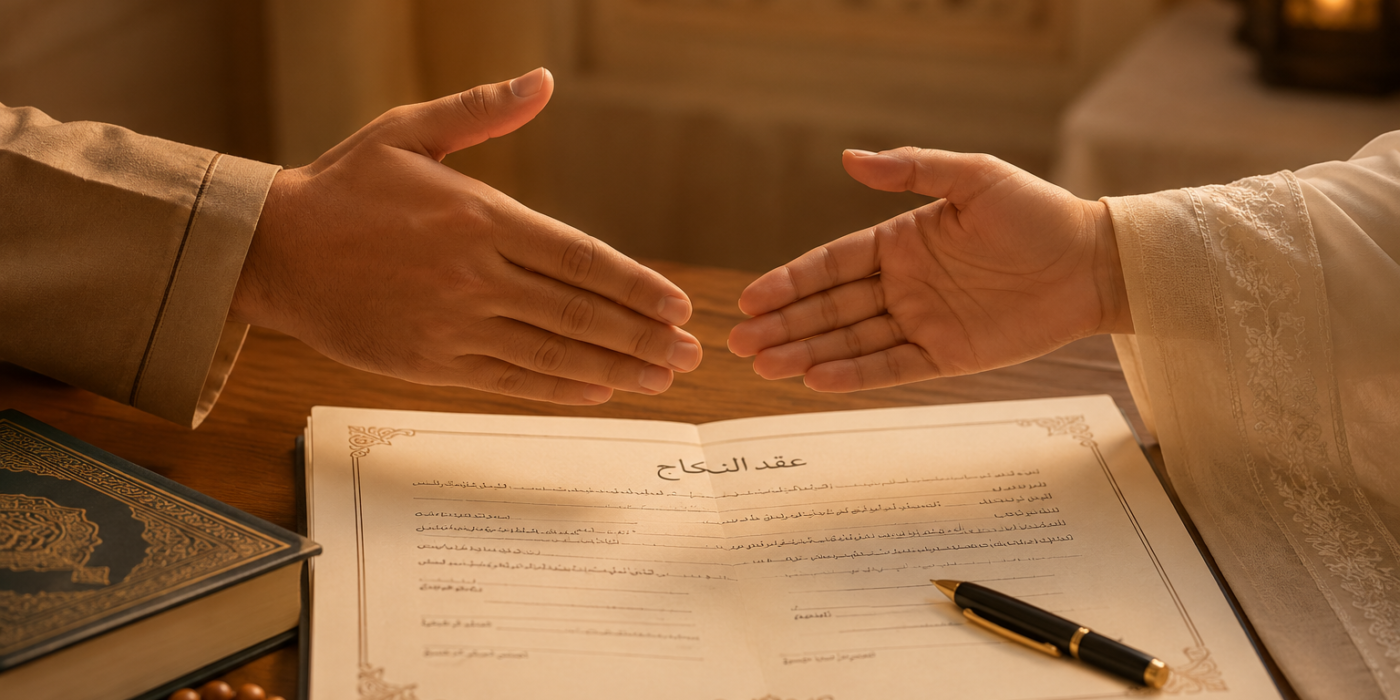
Nikah: Islamic Marriage Requirements and Common Misconceptions
Nikah is one of the most talked-about topics in Muslim communities — and also one of the most surrounded by cultural assumptions that get mistaken for religious requirements. Dowry demands, elaborate mandatory ceremonies, family-only decision-making — plenty of what’s treated as “how nikah works” is actually local custom layered on top of a much simpler religious contract.
What Is Nikah?
Nikah is the Islamic marriage contract — a formal, legal agreement between a man and woman to marry, witnessed and documented, entered into willingly by both parties. It’s described in the Quran as a solemn covenant (mithaqan ghalizan), not merely a social arrangement.
The Actual Requirements for a Valid Nikah
Stripped down to its religious essentials, a valid nikah requires:
- Consent of both parties — a marriage cannot be valid if either person is forced into it against their genuine will
- A proposal and acceptance (Ijab and Qabul) — stated clearly in the presence of witnesses
- Two witnesses — to make the marriage a matter of public record, not a private, undocumented arrangement
- Mahr — a mandatory gift from the groom to the bride, specifically hers to keep and control, not a family transaction
- A guardian (wali) for the bride, according to the majority of scholarly opinion, though the exact role and requirement varies between schools of thought
Notably absent from this list: elaborate ceremonies, expensive venues, or specific cultural rituals — none of these affect the religious validity of the marriage itself.
What Is Mahr, Really?
Mahr is frequently confused with dowry, but the direction of the gift is the opposite. Dowry, as commonly practiced in parts of South Asia, involves the bride’s family giving wealth to the groom’s family — a cultural practice with no basis in Islamic teaching. Mahr is the reverse: a gift from the groom to the bride, and it belongs to her alone, to use, save, or spend however she chooses, with no obligation to share it with her husband or in-laws.
There’s no fixed amount — it can be modest or substantial, monetary or otherwise (a valuable service or item), agreed upon between the couple.
Why Consent Is Non-Negotiable
A well-known hadith describes the Prophet ﷺ specifically asking a woman for her explicit consent before her marriage, and states plainly that a marriage arranged without her consent could be annulled at her request. This directly addresses a common cultural misconception — that family arrangement alone is sufficient regardless of the individual’s own agreement.
The Role of the Walima
The walima is the wedding feast, traditionally hosted by the groom after the marriage, and it’s a recommended Sunnah practice — a way of publicly announcing the marriage and sharing the occasion with the community. It is not what makes the marriage religiously valid; the nikah contract itself does that. The walima is a celebration layered on top of an already-complete marriage.
Common Misconceptions About Nikah
- “A big, expensive wedding is religiously required.” The nikah itself can be simple and low-cost; elaborate weddings are cultural, not religious, requirements — and the Prophet ﷺ specifically praised simplicity in marriage.
- “Mahr belongs to the bride’s family.” It belongs exclusively to the bride herself.
- “Family consent alone is enough, regardless of what the bride or groom wants.” Both parties’ genuine consent is a core requirement, not optional.
- “Marriage in Islam is purely a business contract with no emotional dimension.” The Quran describes spouses as a source of tranquility (sakinah) for one another, and describes the relationship using the language of love (mawaddah) and mercy (rahmah) — far from a purely transactional framing.
Frequently Asked Questions
Is a religious nikah legally recognized without civil registration?
This depends entirely on the laws of the country you’re in — in many places, civil registration alongside the religious nikah is necessary for legal recognition, rights, and documentation. It’s worth confirming local requirements separately from the religious contract itself.
Can the bride set conditions in the marriage contract?
Yes — reasonable conditions agreed upon by both parties can be written into the marriage contract, and many scholars hold that such conditions are binding once agreed.
Does the wali (guardian) have the power to force a marriage?
No — the guardian’s role, according to the majority of scholarly opinion, is not to override the bride’s consent but to represent and support her in the process; a marriage without her genuine agreement is not valid.
Is dating before marriage the same as getting to know a potential spouse in Islam?
Islam permits and encourages structured, appropriate ways for prospective spouses to get to know each other before marriage — typically with family involvement and clear boundaries — distinct from unstructured dating, though the specific approach varies by community and family.
Conclusion
Nikah, at its religious core, is simpler and more protective of both parties — especially the bride — than many cultural practices layered on top of it suggest. Consent, mahr paid directly to the bride, and public witnessing are the actual requirements; everything else is custom, not command.
Browse upcoming Islamic gatherings near you, and see our related piece on ikhlas.