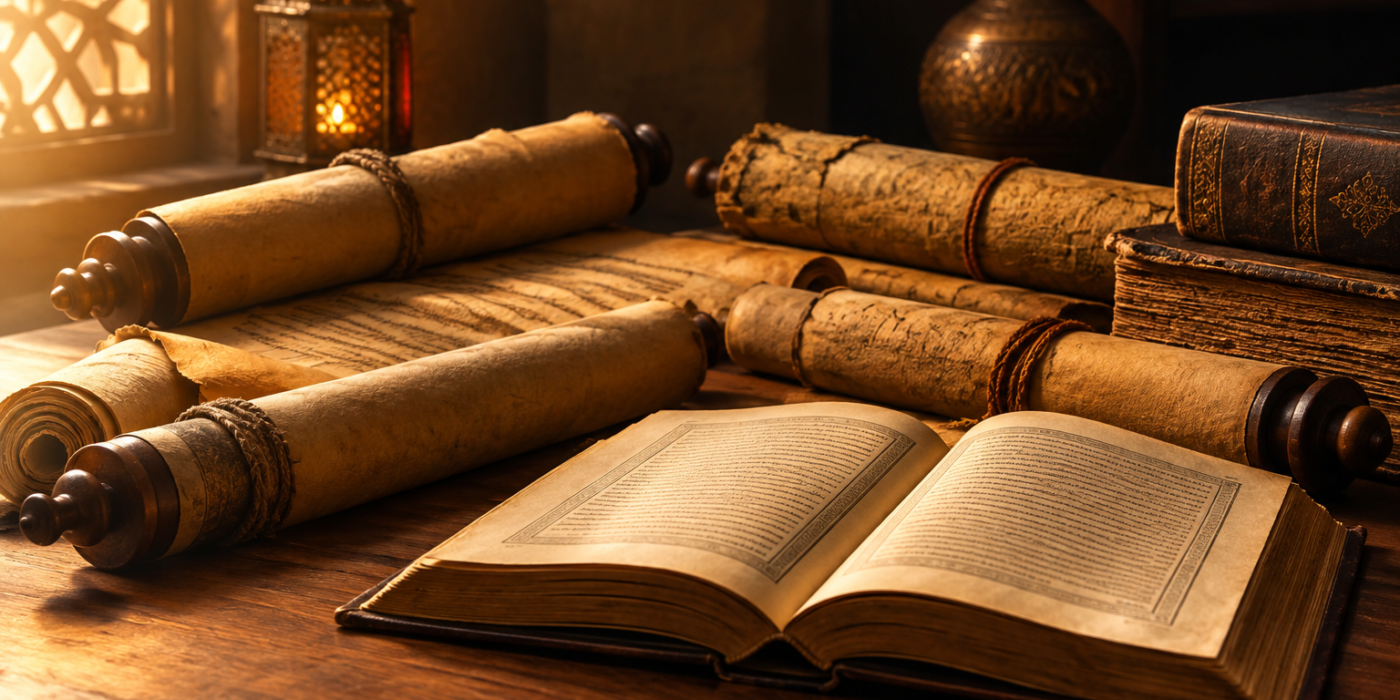
The Books of Allah in Islam: Torah, Psalms, Gospel, and Quran
Quick answer: Belief in the revealed books of Allah is one of the six articles of Islamic faith. Muslims believe Allah sent scripture to various prophets throughout history, including the Torah, the Psalms, the Gospel, and finally the Quran, which is held to be the final, complete, and preserved revelation.
What Does This Belief Actually Require?
Belief in Allah’s revealed books means accepting that Allah communicated guidance to humanity through scripture given to specific prophets across history, not only through the Quran. It also means holding the Quran as the final and complete revelation, superseding and confirming what came before it.
The Named Books in the Quran
Tawrat (Torah)
Revealed to Prophet Musa (Moses, peace be upon him). The Quran refers to it as a source of guidance and light for the people it was given to.
Zabur (Psalms)
Given to Prophet Dawud (David, peace be upon him), mentioned specifically in the Quran as a distinct scripture.
Injeel (Gospel)
Revealed to Prophet Isa (Jesus, peace be upon him), described in the Quran as containing guidance and light, confirming what came before it in the Torah.
Suhuf (Scrolls)
Earlier scrolls given to Prophet Ibrahim (Abraham) and Prophet Musa, referenced in the Quran though not preserved as a distinct text today.
Quran
The final revelation, given to Prophet Muhammad ﷺ. Muslims believe it to be the literal word of Allah, preserved in its original form without alteration since its revelation.
Why Muslims Believe the Quran Alone Remains Fully Preserved
Islamic belief holds that earlier scriptures were subject to changes, additions, and losses over the centuries following their revelation, while the Quran has a distinct promise of preservation. A specific verse states that Allah Himself has sent down the reminder (the Quran) and will be its guardian, a promise scholars point to as the basis for why the Quran, unlike earlier revelations, is believed to remain unaltered in its original Arabic text.
Does This Mean Earlier Scriptures Are Rejected Entirely?
No. Muslims believe in the original revelations given to Musa, Dawud, and Isa as genuine divine communication at the time they were given. What’s understood to have changed over subsequent centuries is the preserved textual accuracy of those earlier scriptures as they exist today, not the legitimacy of the original revelation itself. This is a distinction worth being precise about: the belief affirms the original message, while questioning the preserved accuracy of the surviving texts.
How This Connects to Khatm-e-Nabuwwat
As covered in our piece on the finality of prophethood, the Quran is understood as the final scripture precisely because Muhammad ﷺ is the final prophet. No further revelation is expected, because the chain of prophethood through which revelation was delivered has closed.
Frequently Asked Questions
Do Muslims read the Torah or Gospel as part of their religious practice?
Generally, no, not as scripture for worship or legal guidance, since the Quran is held as the complete and final revelation. Some scholars and students of comparative religion do study these texts academically or historically.
Why does the Quran mention earlier prophets and their books if a new revelation replaced them?
The Quran describes itself as confirming what came before it, not dismissing it. Referencing earlier prophets and scriptures ties the Quran’s message into a single continuous history of divine guidance, rather than presenting it as something disconnected from what preceded it.
Is belief in these earlier books as important as belief in the Quran itself?
Belief in the fact of their original revelation is part of the article of faith itself, though practical religious guidance for Muslims today is drawn from the Quran and Sunnah specifically, not the earlier texts.
Conclusion
Belief in Allah’s revealed books isn’t only about the Quran. It’s about recognizing a single continuous thread of guidance sent to humanity across history, one that Muslims believe reaches its complete and permanently preserved form in the Quran.
See our related piece on Khatm-e-Nabuwwat, and browse upcoming Islamic gatherings near you.